Let me describe a very modern habit.
You find a tool that promises to save you time. It costs a modest monthly fee. Totally reasonable. You sign up.
A few weeks later you find another one. Also modest. Also reasonable. You sign up for that too.
Then comes a premium membership for the thing you already use. A course that teaches you to use it better. An app that tracks how much time you saved. A cloud plan because your storage is full of the files the other apps created.
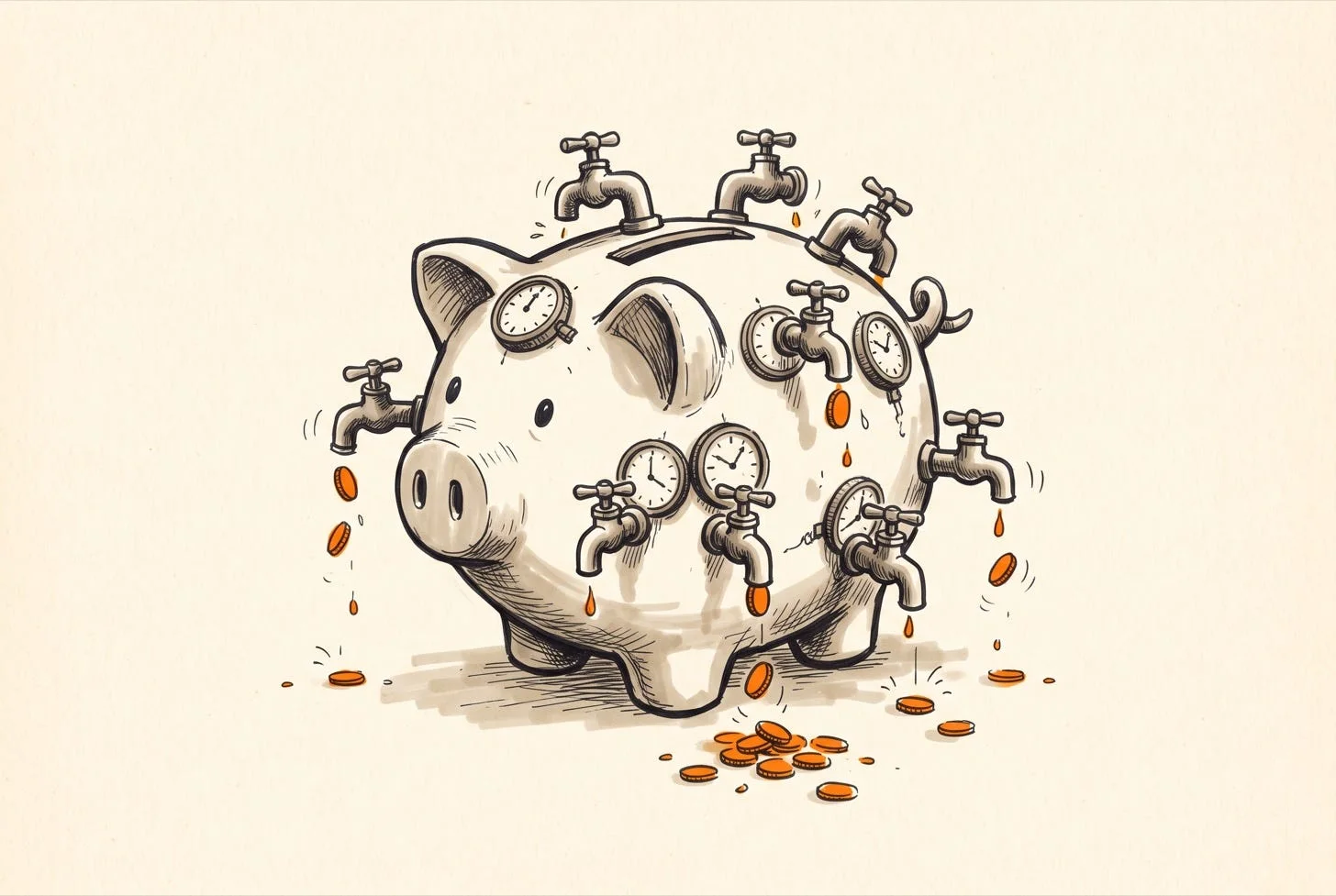
None of these purchases felt big. Each one made sense on its own day. And somewhere in the background a quiet little machine has been taking money from your account on the same date every month.
We are paying more and more money to save more and more money. Let’s look at how that works.
01/ 07
The fee that never announces itself
Subscriptions are a brilliant business model. The company only has to win you over once. After that your inertia does the selling.
The price is deliberately small. A low monthly number does not trigger the part of your brain that deliberates over big purchases. It slips under the radar. And because it renews automatically there is no moment where you are asked “do you still want this?”
You do not decide to keep paying. You merely fail to decide to stop.
India has its own version of this story and it has caught a regulator’s attention. UPI AutoPay and card mandates made recurring payments effortless. So effortless that the RBI has had to write rules around them. Under its e-mandate framework a bank is expected to send you a notification at least 24 hours before an auto-debit goes through. Extra authentication is needed above set limits. News reports put them at ₹15,000 for most payments and ₹1 lakh for categories like mutual funds and insurance. Check the latest RBI circular before relying on the exact numbers.
Think about what that tells you. A system had to be built to remind people that they had agreed to pay. Most of us have at least one mandate we set up in a hurry and then forgot. I could not find a good Indian survey on how much subscription money goes unnoticed so I will not invent a number. But ask a friend to open the AutoPay section of their payments app. The silence that follows will tell you plenty.
02/ 07
A small thought experiment
Picture ten subscriptions that each cost five hundred rupees a month. Music. An OTT platform or two. Cloud storage. A writing tool. A design tool. A fitness app. A news site. A language app. An AI assistant. A premium membership of something.
None of them feels extravagant. Together they add up to five thousand rupees a month. That is sixty thousand rupees a year.
Now ask yourself honestly how many of those ten you used meaningfully last month. If the answer is four then six of them were purely emotional purchases. Insurance against a version of you who might one day learn Spanish.
This is not about shaming anyone. It is about noticing that the sum is far bigger than any single line.
03/ 07
The productivity paradox
Here is the part that amuses me most. A big share of these subscriptions are sold under the banner of efficiency. Save time. Save effort. Save money. Get more done with less.
And in many cases they do. A good tool really can transform how you work. That is why it is worth paying for.
But there is another side. The more tools you stack the more you spend on managing the tools. Logins and updates and integrations and “wait where did I save that.” The system that was meant to simplify your life becomes a small job of its own.
I have written before about how automation can become its own obsession. The broader point here is simpler and more everyday. Saving money has quietly become a monthly expense.
04/ 07
The courses and the memberships
Subscriptions are only half the picture. There is also the one time purchase that behaves like a subscription.
The course to learn the skill. The second course to use the first course properly. The community that gives you access to the people who sell the courses. The template pack. The prompt pack. The “everything bundle.”
Each is a bet on a future version of you who will have time and discipline. Sometimes the bet pays off beautifully. Often it just sits in a folder titled “to start Monday.”
Which brings us to a quiet truth. A lot of what we buy is not the product. It is the feeling of being someone who is working on themselves.
05/ 07
Questions worth asking at the checkout
I try to keep these short.
What is the job? If you cannot describe in one sentence what this subscription does for you then you will struggle to justify it later.
Would I buy this today at full price if I did not already own it? It is a wonderfully rude question for old subscriptions.
What does it replace? A good tool should retire something. If it only adds to the pile then it is a hobby and should be priced like one.
How will I know it is working? Pick a clear signal. Time saved or income earned or work improved. Something you can check.
When will I review it? Put a reminder in your calendar for three months from now. Make cancelling a scheduled event rather than a mood.
06/ 07
A yearly audit
Once a year do a subscription audit. It takes an hour and it feels like finding money in an old coat.
List every recurring charge from your last few statements. Put a number next to each from one to five for how much you actually used it. Cancel anything under a three. Pause the ones you might need later. Keep the ones that clearly earn their place.
Do not be surprised if you find something you forgot. Almost everyone does.
07/ 07
Pay for what pays you back
I am not against paying for good things. Good tools deserve good money. The writers and the engineers and the designers behind them are doing real work.
My only argument is that spending should be a decision and not a default. If a subscription is making your life or work better then enjoy it without guilt. If it is just a habit with an invoice then let it go.
Saving money is a fine goal. But it is hard to do while quietly subscribing to ten different ways of doing it.
What is the oldest subscription you are still paying for and barely using? Be honest in the replies. Nobody is judging.