Open Instagram.
Someone is telling you how Claude can replace your entire creative agency.
Open YouTube.
Someone else has figured out how ChatGPT can run your business while you sleep.
Scroll a little further.
There’s another person showing you how to generate 30 reels in 10 minutes, build an entire website without writing a single line of code, automate your marketing, replace your employees and, apparently, make money without doing much of anything.
And if you haven’t subscribed to at least three AI tools by now, congratulations. According to the internet, you’re already falling behind.
It’s almost funny.
We’ve reached a point where people are spending hours watching videos about how AI can save them time. They’re buying courses to learn how to automate their work, subscribing to increasingly expensive models, collecting prompts, building workflows and connecting one tool to another.
All in the pursuit of being more productive.
But I have a rather simple question.
What exactly are we becoming more productive at?
01/ 10
The internet has a new obsession
A few years ago, the internet was full of productivity hacks.
Wake up at 5 AM. Follow a morning routine. Plan your day. Use a better calendar. Manage your time. Read more books. Build better habits.
The promise was that if you managed yourself better, you could achieve more.
Now, the promise has changed.
You don’t need to manage your time anymore. You need to automate it.
You don’t need to write. AI can write for you.
You don’t need to design. AI can design for you.
You don’t need a marketing team. AI can handle your marketing.
You don’t need an agency. Apparently, one well-written prompt and a Claude subscription should do the job.
Every problem seems to have an AI solution and every solution seems to come with a tutorial explaining how you’re doing things the wrong way if you haven’t automated them yet.
There’s almost a new kind of anxiety being created around technology.
Not the fear that AI will take our jobs, but the fear that someone, somewhere, has figured out a better way to do something that we’re still doing ourselves.
And we don’t want to be the last person to find out.
So we keep watching.
We keep subscribing.
We keep experimenting.
And the cycle starts all over again.
02/ 10
Welcome to the business of selling you productivity
Here’s something worth noticing.
A lot of the content telling you to automate everything is itself part of a business that requires you to keep consuming more content.
Someone makes a video about five AI tools you absolutely need.
Someone else makes a video explaining why those five tools are outdated and introduces seven better ones.
Then comes a paid course teaching you how to combine them.
Then a premium community.
Then a collection of prompts.
Then a subscription to an automation platform.
And just when you think you’ve figured it all out, a new model launches and suddenly your entire workflow needs an upgrade.
It’s a never-ending shopping list disguised as professional development.
I’m not suggesting that everyone selling AI courses or teaching automation is doing something dishonest. There are genuinely knowledgeable people building useful products and sharing valuable information.
But there is an interesting business model emerging around the fear of being left behind.
The message is rarely just that a new tool exists.
It’s that you need it.
Your competitors are already using it. Your business is falling behind. Your workflow is inefficient. You’re spending too much time doing things manually.
And the solution, conveniently, is another product, another subscription or another course.
Somewhere, the promise of saving money has become an increasingly expensive hobby.
03/ 10
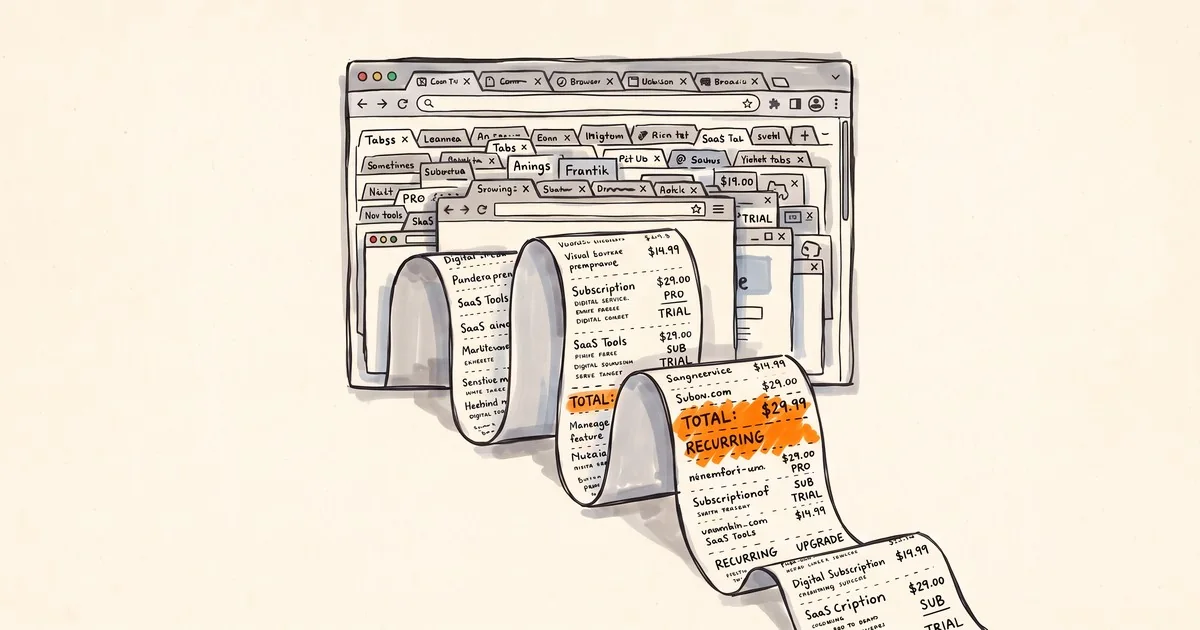
The subscription collection
Let’s talk about the subscriptions.
You start with ChatGPT because everyone is talking about it.
Then you hear Claude is better for writing and reasoning, so you subscribe to that too.
Then someone recommends an image-generation platform.
Another creator introduces an AI video tool.
Someone else shows you an automation platform that connects all your tools together.
Before you know it, your monthly expenses include a collection of AI subscriptions that you originally purchased to make your work easier and more affordable.
And perhaps some of them are genuinely useful.
But how many do you actually use regularly?
How many have become part of a real workflow?
How many have helped you earn more, save meaningful time or improve the quality of your work?
And how many are sitting there because you might need them someday?
It’s an interesting contradiction.
We’re trying to eliminate unnecessary expenses from our businesses while continuously adding new monthly expenses in the name of efficiency.
I’m not against paying for good tools. Quite the opposite. If a tool genuinely improves your work, saves you hours or helps you achieve something you couldn’t otherwise do, it can be worth every rupee.
But a subscription isn’t an achievement.
Having access to intelligence doesn’t automatically make you more intelligent. Having access to powerful tools doesn’t automatically make you better at using them.
And paying for five different AI models doesn’t mean you’ve built a better business.
Sometimes, you’ve just built a more expensive browser history.
04/ 10
We’re automating things we haven’t even understood
This is perhaps the part that concerns me the most.
People are increasingly trying to automate processes before understanding why those processes exist in the first place.
Let’s take a simple example.
A business owner wants to automate their Instagram content.
They find a workflow that generates captions, creates images, schedules posts and publishes everything automatically.
Wonderful.
But what happens if the business doesn’t have a clear brand voice?
What happens if the content doesn’t understand its audience?
What happens if the strategy itself is weak?
Now you’ve automated the production of content that wasn’t particularly useful to begin with.
You’ve made the process faster, certainly. But have you improved the outcome?
The same applies to branding, marketing, communication, customer relationships and almost every other business function.
You cannot automate your way into having a good strategy.
You cannot connect a few AI tools and suddenly develop an understanding of your customers.
You cannot generate hundreds of creative directions without knowing which direction makes sense.
And you certainly cannot fix a poorly understood problem by making its execution more efficient.
Automation can improve a process. It cannot automatically make the process worth doing.
Perhaps before asking what we can automate, we should spend a little more time understanding what we’re actually trying to accomplish.
05/ 10
The illusion of doing more
There’s another thing happening here.
AI has made it incredibly easy to produce things.
More posts. More images. More presentations. More emails. More videos. More ideas.
And because producing more has become easier, we sometimes mistake the quantity of our output for the quality of our progress.
Think about it.
Generating 30 Instagram reels doesn’t mean you’ve built a content strategy.
Creating 100 logo concepts doesn’t mean you’ve built a brand.
Publishing 20 articles doesn’t necessarily mean you’ve established a voice.
Automating 50 tasks doesn’t mean your business is growing.
You can fill an entire month with activity and still make very little progress.
Perhaps this is where we need to rethink our understanding of productivity.
Productivity was never supposed to be about how many things we could fit into a day.
It was supposed to be about doing meaningful things effectively.
But the internet has made productivity look like an endless checklist of tasks that can be completed faster.
And now AI is helping us complete that checklist at an extraordinary speed.
The problem?
Nobody seems to be asking whether the checklist was worth completing in the first place.
06/ 10
Not everything needs to be automated
I find this particularly interesting when it comes to creative work.
There are things I would happily automate.
Repetitive administrative tasks, organising files, resizing assets, preparing routine reports, transcribing meetings and other work that takes up time without necessarily requiring much creative judgement.
If technology can take those things off my plate, I’m all for it.
But there are other parts of the process that I don’t particularly want to automate away.
Thinking through a brand’s identity.
Understanding why a particular visual direction feels right.
Looking at references and making unexpected connections.
Having conversations with people.
Observing things that might become the starting point for an idea.
Experimenting without knowing exactly where something will lead.
These are not inconveniences that need to be eliminated.
They’re part of what makes creative work interesting.
And I think the same principle applies beyond design.
A business owner might use AI to organise customer information but still need to understand their customers.
A writer might use AI to research a subject but still need to develop an original point of view.
A founder might automate reporting but still need to make difficult decisions.
A professional might use AI to work faster without necessarily wanting to remove the human experience from their work.
There is a difference between automating repetitive work and automating the parts of life that give that work meaning.
Perhaps we should be more careful about confusing the two.
07/ 10
The fear of being left behind
I don’t think everyone adopting AI is doing so because they have discovered a genuine need for it.
Some are simply afraid of missing out.
And that’s understandable.
When every other video tells you that your industry is about to change, that your job is at risk, that your competitors are already using AI and that you need to adapt immediately, it’s difficult to sit still.
You start wondering whether you’re doing enough.
Whether you’re learning enough.
Whether your business is moving fast enough.
Whether the person next to you has already figured out something you haven’t.
So you subscribe to another tool.
You watch another tutorial.
You try another workflow.
And for a little while, you feel like you’re catching up.
But technology doesn’t wait for you to catch up.
There’s always another model, another update, another platform and another person telling you about the next big thing.
If your entire relationship with technology is built around not falling behind, you’ll spend a considerable amount of time running after things without ever deciding where you actually want to go.
Perhaps the real skill in this environment isn’t learning every new tool.
It’s developing enough clarity to know which ones deserve your attention.
08/ 10
AI isn’t the problem. Our relationship with it might be
I want to be clear about something.
I’m not arguing against AI, automation or technological progress.
I use these tools. I appreciate what they can do and I genuinely believe they have opened up possibilities that would have seemed almost impossible a few years ago.
They can make independent professionals more capable, help small businesses access resources that were previously expensive and allow creative teams to experiment in entirely new ways.
That’s exciting.
But I don’t think we should accept every promise surrounding AI without questioning it.
Especially when those promises come packaged as shortcuts to success.
A tool can help you write, but it cannot automatically give you something worth saying.
It can help you create visuals, but it cannot guarantee that those visuals communicate anything meaningful.
It can help you build a business workflow, but it cannot decide what kind of business you should build.
It can give you answers, but it cannot replace the importance of knowing which questions are worth asking.
And perhaps most importantly, it can help you save time, but it cannot tell you what to do with that time.
That last part is entirely up to you.
09/ 10
Perhaps we need to become a little less obsessed with automation
I wonder what would happen if we approached AI differently.
Instead of asking, “How can I automate this entire process?”, perhaps we could ask, “Which part of this process is actually wasting my time?”
Instead of subscribing to every new model, perhaps we could become really good at using one or two.
Instead of trying to replace an entire team with AI, perhaps we could use it to make the existing team better at what they do.
Instead of generating endless amounts of content, perhaps we could spend more time making something people genuinely want to engage with.
And instead of treating every human involvement as an inefficiency, perhaps we could recognise that some things are valuable precisely because a human being is involved.
Not everything needs to happen automatically.
Not every conversation needs to be automated.
Not every creative decision needs a model to make it.
Not every task needs a shortcut.
Sometimes, doing something yourself is how you learn to do it better.
Sometimes, the process is just as valuable as the result.
And sometimes, the best decision is to leave something alone.
10/ 10
One last thought
There’s a strange irony in the way we’re approaching this technological revolution.
We’re building increasingly intelligent machines to help us think, create, communicate and make decisions.
And just as those machines are becoming more capable, we’re becoming increasingly eager to hand over the very things that help us develop those abilities ourselves.
We want to automate our writing, our creativity, our communication, our businesses and eventually, perhaps, our thinking.
Meanwhile, an entire internet economy is making money by convincing us that there’s always something else we should automate.
Maybe that’s the real thing worth paying attention to.
Not whether Claude is better at a particular task than ChatGPT.
Not whether the latest model can generate a complete marketing campaign.
Not whether someone has discovered a workflow that promises to save you another five hours a week.
But whether all this technology is helping us do more meaningful things, or simply giving us more ways to avoid doing things ourselves.
Because the ultimate goal of technology was never supposed to be making human beings unnecessary.
It was supposed to make human beings more capable.
And perhaps the most productive thing we can do in the age of AI is learn when to use it, when to question it and when to simply close the tab.
The internet wants you to automate everything.
Perhaps it’s time we asked ourselves what we’re trying so hard to get away from doing.
An observation on AI, the productivity economy and our growing obsession with automating almost everything.