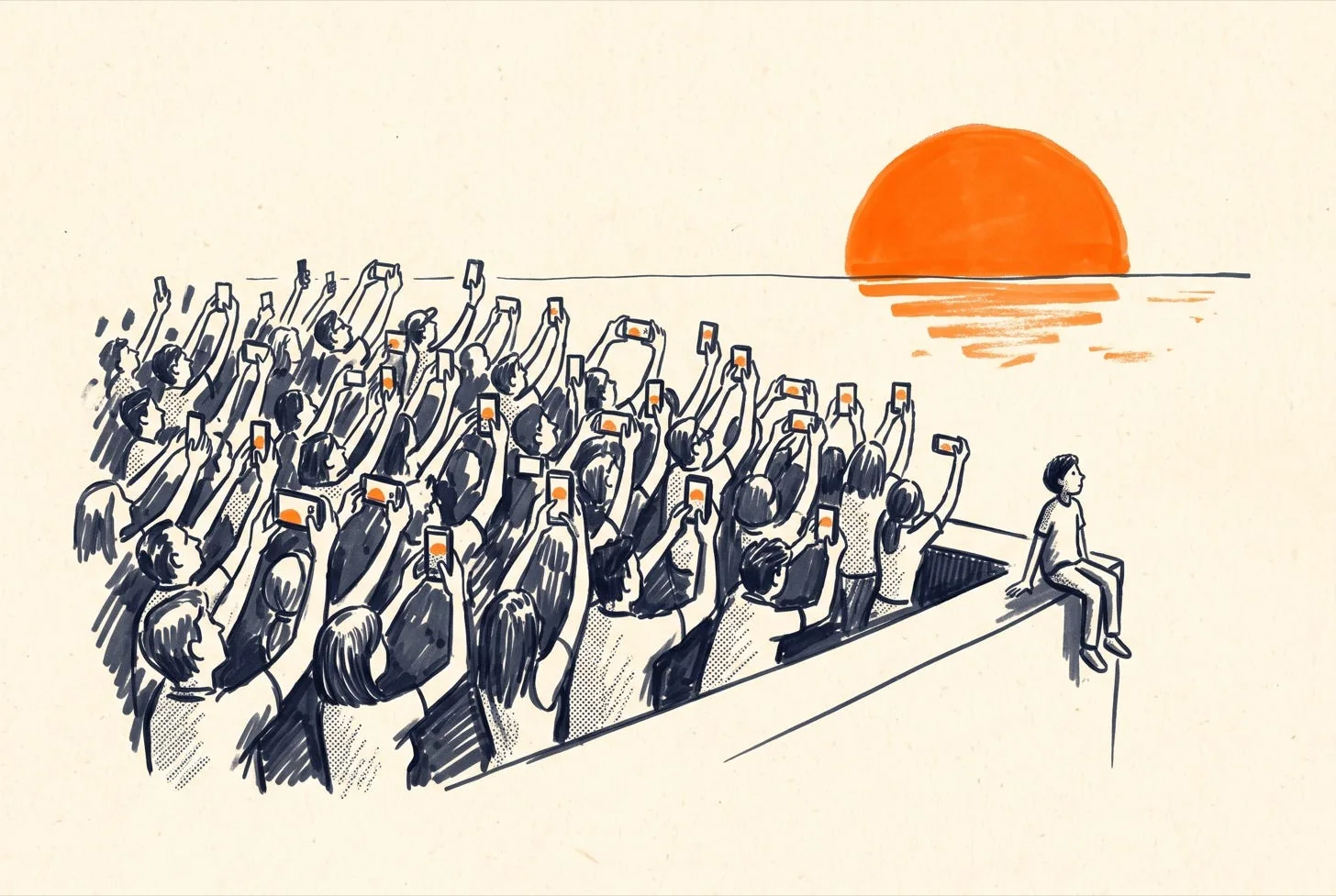
Picture the evening aarti at a ghat in Varanasi.
The lamps are lit. The bells are ringing. The Ganga is doing that thing where it turns the colour of the flames. Hundreds of people are standing on the steps watching it.
Now count how many of them are looking at it directly.
Not through a screen. Not while angling a phone for the best composition. Not while tapping the little exposure slider. Just looking.
If your count is low you have already noticed the strange thing about modern life. We have built a world where the aarti is a rumour until it has been posted.
01/ 06
When did the proof become the point
There was a time when you went somewhere because you wanted to be there. The photograph was a souvenir. It came after the experience and it was a small footnote to it.
Somewhere along the way the order flipped. Now many of us go somewhere partly because it will look good once we have been. The cafe is chosen for its lighting. The trip to Manali is chosen for its Instagram spot. The thali is photographed before the first bite and eaten after it has gone cold. At a big Indian wedding it is not unusual to see guests watching the pheras on their phone screens while the real ones happen two feet away.
I want to be careful here. Sharing things is lovely. Wanting to show someone you love a beautiful moment is one of the most human instincts there is. I am not talking about that.
I am talking about the quiet moment when the question changes from “am I enjoying this” to “how will this look.”
Those are not the same question. And only one of them is about you.
02/ 06
Your memory has opinions about this
Here is where it gets properly interesting. A psychologist named Linda Henkel ran a study at a university art museum. She took people on a tour and told them to either look at certain artworks or photograph them.
The result became known as the photo-taking impairment effect. People who photographed an object remembered fewer details about it than people who had only looked. Later research has found the effect again in other settings. One interesting twist in her own work is that when people zoomed in on a specific detail while photographing it the memory loss mostly disappeared.
So the camera is not the villain. The inattention is. The study was in a museum but you can easily imagine the same thing at the evening aarti or in front of the Taj Mahal at sunrise.
When you hand the moment to the phone your brain seems to quietly decide that someone else is now responsible for remembering it. You walk away with a file. You do not walk away with the experience.
Which means we are collecting proof of memories we did not fully make.
03/ 06
The strange economics of being seen
Let’s talk about why this happens because it is not just vanity.
Social platforms reward the visible. A thoughtful afternoon of doing nothing earns no engagement. A well framed photo of that afternoon might earn plenty. Over time we learn what gets noticed and we begin to live a little more toward it. Nobody sits down and decides to do this. It is a thousand tiny nudges adding up.
There is also a gentle pressure from the other direction. When everyone else seems to be having remarkable weekends then a quiet one begins to feel like a failure of imagination. So we upgrade the weekend. Or at least the appearance of it.
And there is the new twist. Everyone is now a creator. Everyone has a content calendar of their own life. The grandmother’s birthday is raw material. So is the sangeet. The holiday is a series. The breakup is a thread.
None of this is evil. Much of it is creative and funny and genuinely moving. But when everything is potential content nothing is allowed to be just an afternoon.
04/ 06
An uncomfortable test
Try this the next time something wonderful is happening around you.
Ask yourself whether you would still want to be here if nobody ever saw it. If the answer is yes then you are probably fine. Take the photo. Enjoy it twice.
If the answer is no then something worth noticing is going on. Not guilt. Just information. It may mean the thing you are doing is not actually yours. It may be a performance for an audience that has not even arrived yet.
I find that a surprisingly freeing question. A lot of what we do for show turns out to be something we would never choose in private.
05/ 06
Small rules that help
I am not going to tell you to delete your apps and move to a cabin. Most of us would last four days and miss the group chat.
But here are a few small habits that seem sensible and cost almost nothing.
Look first. Then shoot. Give the moment a full minute with your own eyes before the phone comes out. The photo will still be there. The first look will not.
Take fewer photos and take them closer. Henkel’s own results suggest that looking carefully for a detail worth capturing keeps the memory alive. One photo you thought about is worth twenty you did not.
Keep one thing off the record. Pick one meal or one walk or one conversation a week that never appears anywhere. Not because it is secret. Because it is yours.
Post later. Share the moment after it is over. The experience gets to finish before the audience arrives.
06/ 06
What are we saving it for
Here is the plain version of everything above. A moment that is documented is not the same as a moment that is lived. We all know it. We just keep forgetting.
Because documentation is easy and living takes attention. And attention is the one resource that every app we own is quietly competing for.
So the next time the sun slips behind the hills or the lamps are lit at the ghat give it a minute. Let your eyes do the work. Let your memory hold the receipt.
Then take the photo if you still want to.
And tell me honestly in the replies. When did you last do something wonderful and tell absolutely nobody about it?