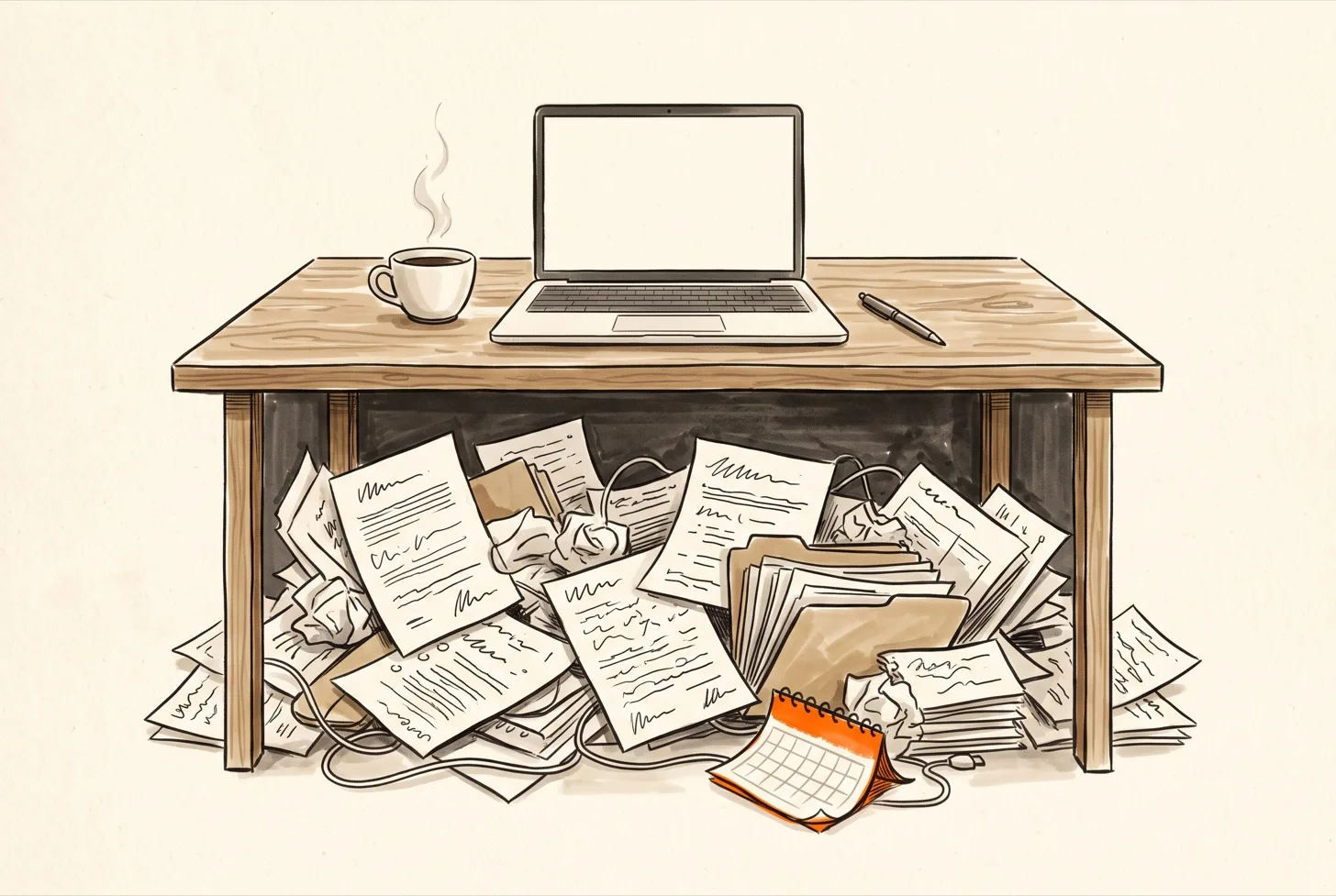
Here is the Instagram version of starting a business.
A laptop on a wooden table. A coffee in a nice cup. A caption about freedom and hustle and “building something that is mine.” Perhaps a sunrise. Perhaps a dog.
Here is what the picture does not show.
It does not show the invoice that has been outstanding for forty days. It does not show the polite follow up email that sounds cheerful while you feel faintly ill. It does not show the client who wants “something clean but also bold but also exactly like what they have seen elsewhere.” It does not show the moment you check your bank balance and then check it again as if it might have changed in ninety seconds.
Being your own boss sounds lovely. And it is, in certain ways. But the phrase leaves out a small detail. When you become your own boss you also become your own HR department and accounts team and sales team and tech support. And your boss is a deeply unreasonable person who never lets you go home.
01/ 06
The tidy lie
I do not think the glamorous version is malicious. It is just selective. People post what looks good. A calm Tuesday of invoicing and emails and fixing a typo for the sixth time does not make good content.
But when a whole generation consumes only the highlight reel a distorted picture forms. Entrepreneurship starts to look like a lifestyle rather than a job. Like a personality rather than a series of difficult decisions. Like a destination rather than a long uncertain walk.
There is a famous gap between expectation and reality in every career. Business ownership has an unusually wide one because the marketing is so good.
02/ 06
What the law quietly admits
Here is something worth noticing. India had to write a rule about late payments.
Anyone running a small business here knows the feeling. You deliver the work. The invoice goes out. And then you wait. And follow up. And wait some more. The problem is so common that the law stepped in. Under the MSMED Act a buyer is expected to pay a micro or small enterprise within 45 days if there is a written agreement or within 15 days if there is none. And since the Finance Act 2023 a business that does not pay a registered micro or small supplier within those limits cannot claim that expense as a tax deduction until it actually pays.
Two caveats. These rules cover registered micro and small enterprises and the details are technical so check with a chartered accountant before relying on them. And a rule on paper is not the same as money in your account.
Still the point stands. When a country writes a law about late payments it tells you how common the problem has been. Running a business is harder than anyone shows you.
03/ 06
The unglamorous parts nobody posts
Let me offer a short and unofficial list. These are widely recognised realities of independent work. Not confessions. Just things that tend to be true.
Cash flow is the real boss. Revenue and money in the bank are not the same thing. A great month on paper can still be a tense month if the payments arrive late. Plenty of small businesses struggle not because of a lack of work but because of a gap in timing.
Compliance never sleeps. GST returns and TDS and advance tax and the filing calendar do not care whether your client has paid you yet.
Clients are a mixed bag. Some are wonderful. They trust you and pay on time and tell their friends. Others say “sirf ek chhota sa logo hai” as if the thinking were free. Some change the brief halfway through and then ask why the project is late. Learning to tell them apart before signing is a skill that no course fully teaches.
You sell more than you create. Many creative founders imagine spending their days making things. In practice a big slice goes into finding work and explaining your value and negotiating. The craft is only one part of the job.
Saying no is a financial decision. Turning down the wrong project at the wrong time takes nerve because rent does not care about your principles. But saying yes to everything usually costs more in the long run.
Uncertainty never fully leaves. It changes shape. Early on it is “will anyone hire me.” Later it is “will this client stay.” The feeling just finds a new address.
04/ 06
So why does anyone do it
That list sounds grim. It is not meant to be. People keep starting things for good reasons.
Because it is a way to build something that reflects what you believe. Because control over your work can feel like oxygen. Because when it goes well the satisfaction is of a different quality altogether. Because some people simply cannot imagine doing it any other way.
The honest case for entrepreneurship is not that it is easy. It is that it is yours. You get to own the wins and the mistakes and the story.
That deal is worth taking for some people. But it should be taken with open eyes. Not because a reel made it look like freedom.
05/ 06
Questions worth asking before you start
A few that I think are more useful than any motivational quote.
How many months could I survive with no income at all? Do I have at least a few clients or customers already interested or am I hoping they will appear? What part of the day-to-day work would I actually enjoy? What would I do if my best client left tomorrow?
If you can answer those honestly you are already ahead of most of the highlight reels.
06/ 06
The caption that should exist
I would love to see more honest posts about this. Not complaints. Not trauma dumping. Just accuracy.
Something like this. “Day 312. Sent four invoices and two awkward reminders. Lost one pitch. Won a small one. Figured out a better way to price my work. Still here.”
That does not get many likes. But it might help the next person decide more wisely.
Because the best thing you can do for people thinking of starting out is to describe the road as it really is. Including the potholes. Especially the potholes.
If you run your own thing tell me in the replies. What is the part nobody warned you about?