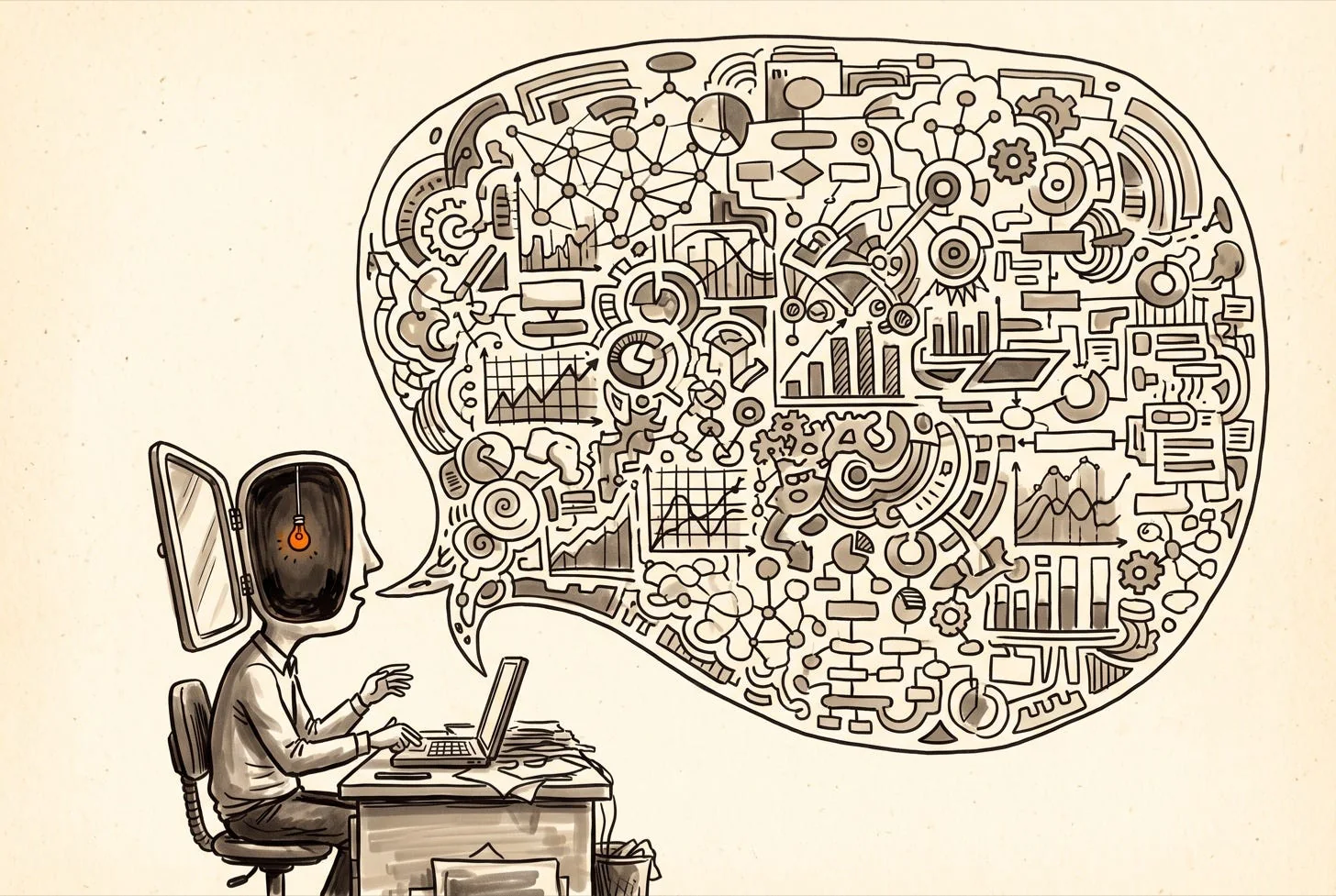
There is a new kind of person in every meeting now. In a Bengaluru startup. In a Delhi agency. In a family business in Ludhiana.
They arrive with a perfectly structured opinion. They use words like “framework” and “second-order effects.” They can summarise a forty page report in three confident sentences. They are, by every visible measure, brilliant.
Then someone asks a follow up question. Just one. Not a trick question. Something like “why do you think that?”
And the room goes quiet for half a second too long.
I am not mocking anyone. Most of us have been that person at least once. What interests me is the gap between how smart we now look and how much of that smartness actually lives inside our heads.
01/ 07
We have never looked this intelligent
Let’s be fair first. AI tools are astonishing. They can explain a concept you have been avoiding for years. They can tidy a messy thought into a clean paragraph. They can make a nervous beginner sound like a seasoned professional in about eleven seconds.
That is a real gift. I am not here to tell you to throw your laptop into a river.
But notice what has quietly changed. For most of history the output of a person was a rough proxy for what was going on inside them. A well argued essay suggested a well trained mind. A sharp question suggested real curiosity. You could not easily fake the thinking because the thinking was the work.
Now the output and the thinking have come apart. You can produce the first without doing the second. And the strange part is that nobody can tell. Sometimes you cannot tell either.
02/ 07
This is not our first rodeo
In 2011 a team of psychologists published a paper in Science called “Google Effects on Memory.” Betsy Sparrow and her colleagues ran a set of experiments and found something quietly unsettling. When people expect that information will be easy to look up later they remember the information itself less. What they remember better is where to find it.
The authors described the internet as a kind of external memory. We stopped filing facts in our heads and started filing directions to facts instead.
Was that a disaster? Not really. Most of us can live with forgetting a capital city. Outsourcing trivia is cheap.
But AI does not only hold trivia. It holds the thinking. The structuring and the weighing and the noticing that this argument has a hole in it. That is a very different thing to hand over.
03/ 07
India has seen this movie before
Anyone who went to school here knows the guess paper. Those slim booklets that promised the questions that would “definitely” come in the exam. Or the ready made notes that went around before the boards. Or the coaching class trick for a tricky formula. They worked just well enough to be dangerous. You could score without understanding.
Then came WhatsApp University. Forward after forward of confident paragraphs that nobody wrote and nobody checked. Smooth text with no author is hardly new for us.
AI is the most elegant guess paper ever made. It is better written. It is more patient. It never runs out of pages. Which is exactly why the old question matters more than ever. Did you learn the thing or did you only collect the answer?
04/ 07
About that brain scan study
You may have seen the headline. In 2025 researchers at the MIT Media Lab released a study where people wrote essays while wearing EEG caps. Some used ChatGPT. Some used a search engine. Some used nothing. The group using the chatbot showed the weakest connectivity between brain regions and had more trouble quoting their own essays afterwards.
It went viral as “ChatGPT is rotting your brain.”
Here is the honest version. It was a small study with 54 participants. It was a preprint which means it had not been peer reviewed when it came out. It only looked at essay writing. And the lead author has said publicly that it did not measure intelligence and should not be read as proof of brain damage.
So no. Nobody has shown that AI makes you dumber. What the study does suggest is smaller and more believable. When a tool does the effortful part of a task your brain does less of the effortful part. Which is hardly shocking. A forklift does not make you stronger either.
The question is whether strength was the point.
05/ 07
The fluency trap
There is a psychological trap hiding in all this. When something reads smoothly we assume we understand it. Clean sentences feel like clear thinking. A tidy summary feels like knowledge.
But understanding has a texture that fluency does not. It is the feeling of being able to rebuild an idea from scratch. Of knowing where it breaks. Of being able to explain it to a ten year old or argue against it at a dinner table.
You find out whether you have that texture only when the tool is not in the room.
Try it as a small experiment. Take the last thing you learned with AI help. Close every tab. Explain it out loud to nobody. Notice where you start waving your hands.
That hand waving is the real map of what you know.
06/ 07
What I would keep doing the slow way
I do not think the answer is purity. I think it is choosing.
Some things are worth the friction. Here is my short list and you are welcome to disagree with it.
The first draft of your own opinion. Decide what you think before you ask what the machine thinks. Otherwise you are not collaborating. You are editing someone else’s idea and calling it yours.
The thing you will be asked about out loud. If you will have to defend it in a room then you should have actually built it.
One hard thing a week. Read something difficult with no summary. Work through a problem on paper. Let your brain feel the grind. It is a muscle and muscles are famously unmoved by good intentions.
And the rest? Let the machine take the rest. The formatting and the boilerplate and the fifth reformatted version of an email. Hand over the drudgery and keep the thinking.
07/ 07
The smartest thing in the room
The oldest sign of intelligence was never having the answer. It was the quality of your questions. Curiosity is the part that does not automate well because it starts with not knowing. And not knowing is the one feeling a tool is designed to remove.
So here is what I would like you to sit with.
If every tool you own disappeared tomorrow morning what would you still be able to think through on your own? Not what could you look up. What could you reason out?
I suspect the answer is more than you fear and less than you would like.
That gap is worth closing. And it closes the same way it always has. By doing the hard part yourself a little more often than is comfortable.
What is the last thing you figured out entirely on your own? I would genuinely like to know. Tell me in the replies.